Goods move fast. The books keep up.
Every purchase, sale, return and godown transfer updates the accounts at the same time. Stock and party balances are always current, because they come from the same entries.
A day on the trading floor
- 01
Receive the morning consignment
The GRN records quantity, batch and godown. When the supplier bill arrives, it links to the same receipt — purchase, stock and ITC in one motion.
- 02
Dispatch against orders
Delivery challans go out with the tempo; invoices follow from the same screen, drawing stock down per warehouse.
- 03
Rebalance the godowns
Andheri is low on fast movers. A transfer from Bhiwandi carries batches with it — FEFO order preserved at the destination.
- 04
Process a return
Four shirts come back from Sharma Stores. The credit note links to the original invoice; stock and the receivable adjust together.
- 05
Close with the position
Stock position by warehouse, ageing by customer, and today’s dispatch value — checked in minutes before the shutters drop.
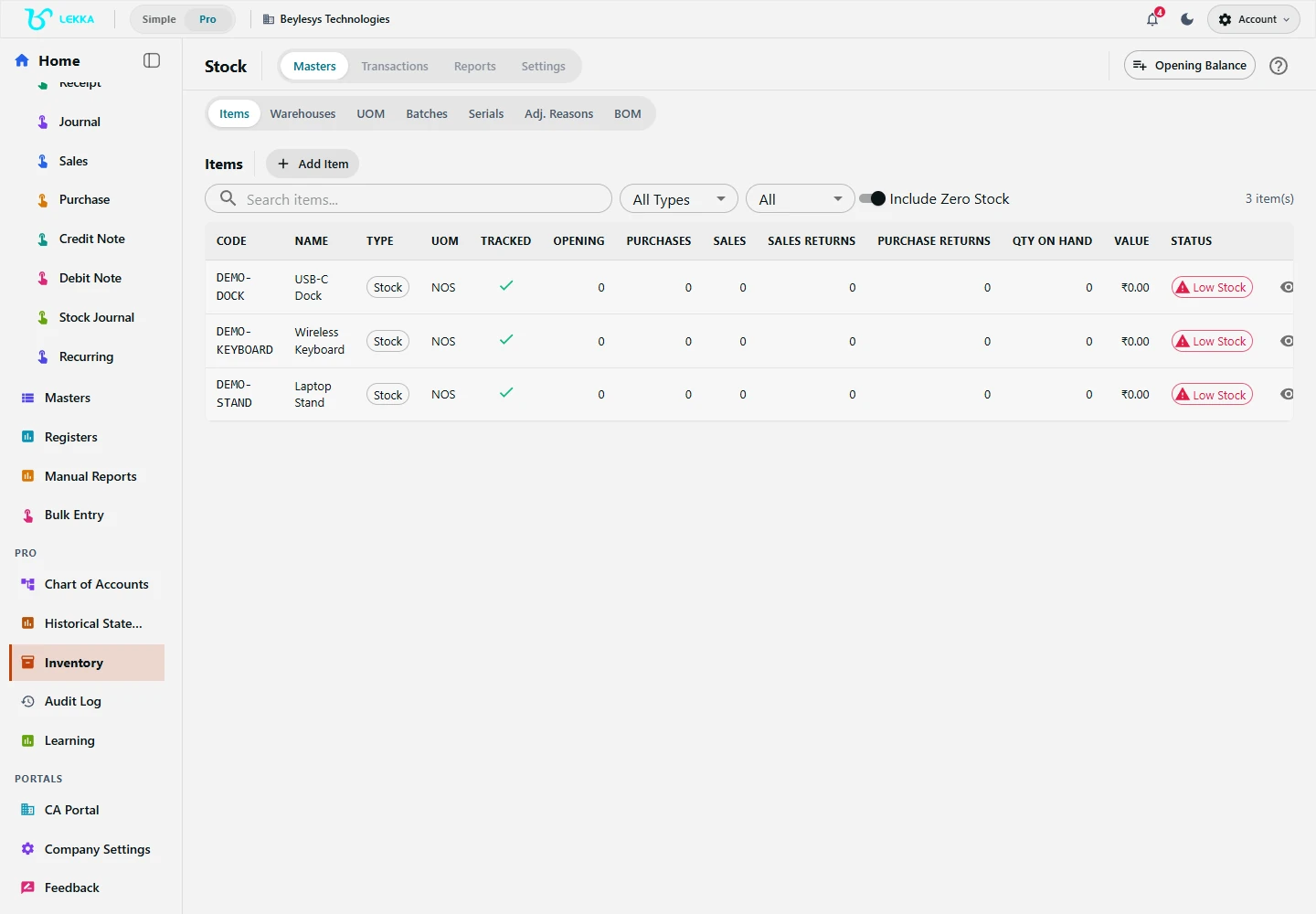
Manage the stock items used in your inventory records.
Beylesys Technologies · local test company · sample recordsLess chasing. More getting things done.
"Stock says one thing, accounts another."
A separate stock register and accounting package drift apart until month-end reconciliation becomes a project.
Every movement — receipt, dispatch, transfer, return — is one entry that updates quantities and ledgers together.
"Returns create loose ends."
Goods come back, the credit note is raised somewhere else, and neither the shelf nor the ledger is quite right.
Credit and debit notes link to the original transaction; stock, receivable and GST adjust in the same step.
"Which godown has what is a phone call."
Multi-location stock lives in someone’s memory or a WhatsApp group.
Location-wise stock position is live, transfers show in-transit quantities, and batches keep their expiry order across moves.
What changes for a trader
The practical gains when goods and accounts share one system.
1 entry
per movement — stock and accounting update together
0 calls
to ask which godown holds what — the position is live
FEFO
expiry order preserved across batches and transfers
Linked
returns, credit notes and invoices — a trail your CA can follow
Choose Plus for a team in one business, or Max for several businesses. Confirm inventory access, team limits and current prices in your account.
FAQ's
Raise a credit or debit note against the original transaction. Stock, party balance and GST adjust in the same linked step.
Batch tracking with FEFO is built in — it suggests which batch to dispatch and keeps expiry order across transfers.
Basic bill-of-materials and production orders cover component-to-output work. It isn’t a full manufacturing ERP — and doesn’t try to be.
Run the godown from one system.
Explore the workflow, create your items and warehouses, and run one full receipt-to-return cycle on real data.